
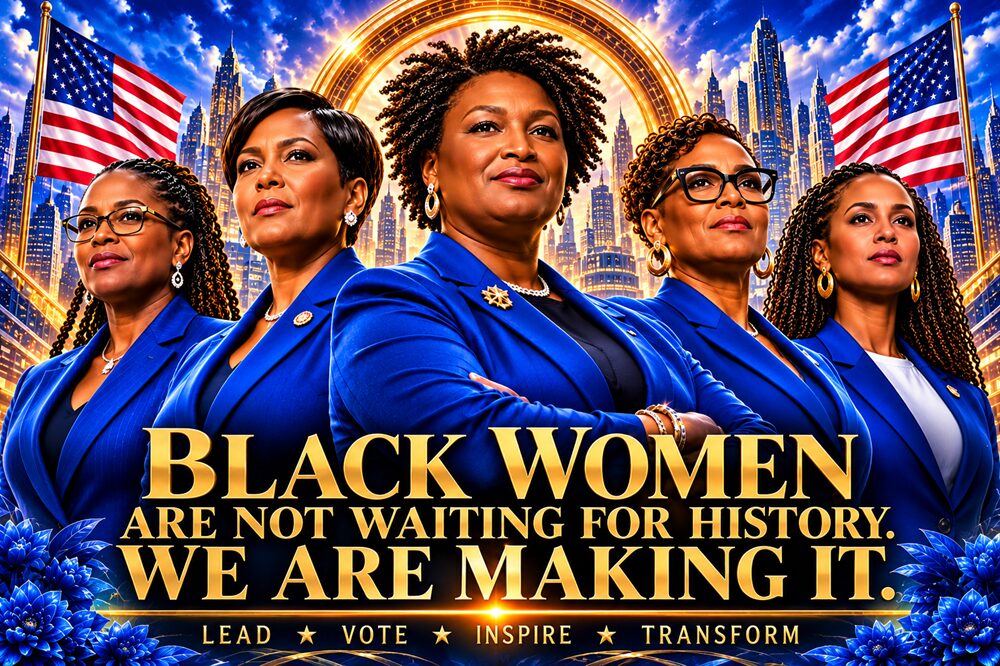
There are moments in history when the strength of a people becomes impossible to ignore. Moments when determination, courage, persistence, and the refusal to give up become visible in ways that demand recognition.
The 2026 election cycle gave us one of those moments.
Across the country, Black women stepped forward as candidates, organized their communities, cast their ballots, challenged expectations, and won elections. Some made history by becoming the first Black women to hold particular offices. Others continued building on the work of generations who fought to make political participation possible in the first place.
But this story is about much more than election results.
It is about Black women’s resilience. It is about women who continue to lead, even when the political environment is hostile. It is about women who keep showing up despite the obstacles, the criticism, the underestimation, and the forces that would prefer to see them discouraged or absent.
And it is about the voters who understand that representation matters.
The Primary Elections: Black Women Stepping Forward
The 2026 primary elections gave us an opportunity to see Black women competing for positions of influence at every level of government.
In Illinois, Lieutenant Governor Juliana Stratton won the Democratic primary for the open U.S. Senate seat. She went on to win the general election, becoming Illinois’ next U.S. senator.
In Georgia, Keisha Lance Bottoms won the Democratic nomination for governor. She went on to make history in November.
Other Black women also stepped forward in congressional, statewide, and local races across the country. Their campaigns represented something important: Black women are not limiting their ambitions or waiting for invitations to participate in the political process.
Every woman who enters a race challenges assumptions about who belongs in leadership. Every campaign creates another opportunity for communities to see themselves represented.
And every victory builds on the work of women who came before.
November 3: Historic Victories
The November 3, 2026 general election brought historic victories for Black women.
Keisha Lance Bottoms won Georgia’s governor’s race, becoming the first Black woman elected governor in United States history. This is an extraordinary milestone. For generations, Black women have participated in American democracy while facing barriers to the highest levels of political power. A Black woman winning a governor’s office is a moment future generations will be able to look back on.
Juliana Stratton won the Illinois U.S. Senate race. Her election means three Black women will serve in the U.S. Senate simultaneously for the first time: Angela Alsobrooks of Maryland, Lisa Blunt Rochester of Delaware, and Juliana Stratton of Illinois.
In Colorado, Melat Kiros became the first Black woman elected to represent the state in Congress. She also became the first Generation Z woman elected to Congress.
In New York, Adrienne Adams won election as lieutenant governor, becoming the first Black woman elected to that office in the state.
And in Nevada, Tya Mathis-Coleman won election as state treasurer, becoming the first Black woman to serve in statewide elective executive office in Nevada.
These are not small accomplishments. They are historic changes in the landscape of American political representation.
And while we celebrate these women, we should also recognize the communities, volunteers, organizers, families, and voters who helped make these victories possible.
No historic achievement happens in isolation.
Black Women in Congress: Representation Matters
Black women serving in Congress are part of a legacy that continues to grow.
From the Senate to the House of Representatives, Black women have brought their experiences, perspectives, expertise, and priorities into the national legislative conversation.
Angela Alsobrooks, Lisa Blunt Rochester, and Juliana Stratton represent a historic milestone: three Black women serving together in the Senate.
In the House, women such as Maxine Waters, Yvette Clarke, Ayanna Pressley, Jasmine Crockett, and other Black women lawmakers continue to contribute to national debates, legislation, oversight, and public policy.
Their political approaches and priorities are not all identical. Black women are not a monolithic group, and representation does not mean every woman thinks the same way.
But the presence of Black women in these institutions matters.
It matters because the people making decisions should reflect the diversity of the people affected by those decisions. It matters because lived experiences can inform public policy. And it matters because young Black girls deserve to see women who look like them occupying positions of authority and influence.
Black Women Voters: A Powerful Political Force
We cannot tell the story of Black women’s political influence without talking about Black women voters.
According to the 2026 Voter Poll by SSRS, conducted for ABC, the Associated Press, CBS, CNN, Fox, NBC, and MS NOW, approximately 93% of Black women voters supported the Democratic candidate in their local U.S. House race. The poll also estimated that Black women represented 5% of all voters.
It is important to understand what those numbers mean. The 93% figure describes the estimated voting preference of Black women who voted. It does not mean that 93% of all Black women participated in the election.
Still, the finding highlights the extraordinary political influence Black women can have in elections.
And the story does not stop with Election Day.
The NAACP reported that Black early and absentee voting increased compared with the same point in the 2022 midterm election. Reported increases ranged from 20% in Georgia to 53% in Texas. These comparisons concerned early and absentee voting, not Election Day voting.
That is meaningful evidence of the organizing, planning, and civic participation taking place in Black communities.
Black women are not simply being discussed as a voting demographic. We are organizers, volunteers, advocates, campaign workers, community leaders, candidates, and voters.
We are part of the work that shapes political outcomes.
943 Candidates. 502 Elected. And More Results to Come.
One of the most remarkable snapshots of this election cycle comes from the Sisters Lead Sisters Vote 2026 tracker.
According to its preliminary report updated November 8, the organization confirmed 943 Black women candidates on the 2026 ballot across 45 states and territories. Of those candidates, 502 had been elected, while 135 races were still being counted.
The tracker also reported that 724 candidates made it to the November ballot, and 262 Black women had been elected to state legislatures.
These figures are preliminary and may change as additional results are finalized. But even as a snapshot, they illustrate the breadth of Black women’s participation in American politics.
Think about what that represents.
Hundreds of Black women made the decision to put their names on ballots. They entered races, built campaigns, spoke to communities, faced opposition, and pursued opportunities to serve.
And hundreds won.
Some victories may not receive national television coverage. Some women won local offices that will never become major headlines. But local government affects everyday life in profound ways.
School boards, city councils, county commissions, judicial offices, state legislatures, and statewide positions all influence the communities in which we live.
Every one of those seats matters.
Resilience Is Part of Our Political History
The resilience of Black women in American politics did not begin in 2026.
It comes from generations of women who fought for the right to participate in a democracy that repeatedly attempted to exclude them.
Black women were active in the struggle for voting rights long before the Voting Rights Act of 1965. They organized communities, challenged discriminatory systems, educated voters, and worked to protect the rights of others even when they were denied those same protections.
The obstacles have changed over time, but the determination has continued.
Today, Black women in politics can face intense scrutiny, racial hostility, sexism, threats, harassment, underestimation, and political opposition. They may be criticized for speaking too forcefully, dismissed when they demonstrate expertise, or judged by standards that are not equally applied to others.
And yet they continue.
They continue to run for office. They continue to organize. They continue to speak. They continue to vote. They continue to lead.
That resilience deserves recognition.
Not because Black women should have to endure unfair treatment, but because the fact that so many continue to pursue leadership in spite of those barriers speaks to their determination and commitment.
We should not romanticize the obstacles. We should work to remove them.
The Work Does Not End When the Election Is Over
Celebrating Black women winning elections is important. But representation is only one part of the responsibility.
The next chapter is about what happens after the victory.
It is about holding elected officials accountable. It is about paying attention to legislation, policy decisions, appointments, budgets, and the promises made during campaigns.
It is about supporting women who are doing meaningful work, regardless of whether their political views align perfectly with our own.
And it is about continuing to create opportunities for the next generation.
We should want young Black girls to grow up understanding that leadership is not reserved for someone else. They should be able to imagine themselves as elected officials, attorneys, judges, governors, senators, representatives, organizers, and decision-makers.
They should see examples of women who have walked into spaces where they were not always welcomed and still found a way to lead.
The goal is not simply to make history once. The goal is to create a future in which Black women’s leadership is no longer treated as an exception.
Black Women Are Making History
The 2026 election cycle gave us plenty to celebrate.
We witnessed historic victories. We saw Black women enter races across the country. We saw communities organize and voters participate. We saw women break barriers that had stood for generations.
But perhaps the most important message is this:
Black women are still here.
We are still building. We are still organizing. We are still leading. We are still participating in the decisions that shape our communities and our country.
To every Black woman who ran for office, congratulations.
To every Black woman who won, congratulations.
To every Black woman serving in Congress and in public office at every level, your work matters.
To every Black woman who volunteered, organized, encouraged another woman to run, helped a neighbor get to the polls, or cast a ballot herself, your participation matters.
And to every Black woman who has ever been discouraged from pursuing leadership, who has been underestimated, who has been told that she does not belong, or who has been made to feel that her voice is not important: your voice matters.
We do not have to wait for everyone to recognize our strength before we recognize it ourselves.
We do not have to wait for history to give us permission to make it.
Black women are not waiting for history to recognize them. They are making history, shaping the present, and helping determine the future.
Love,
Keonna
Editorial note: Election results and candidate totals reflect information available at the time of research. Some results remain preliminary or subject to official certification. The Sisters Lead Sisters Vote candidate totals cited above are its November 8, 2026 snapshot.
Sources and Further Reading
The following sources provide election coverage, research, voting data, and additional information supporting the facts discussed in this article.
- Sisters Lead Sisters Vote — 2026 Candidate and Election Tracker
Preliminary national figures for Black women candidates, election outcomes, state legislative victories, and voter data. - Joint Center for Political and Economic Studies — Black Representation in the 2026 Midterm Elections
Analysis of Black representation in the incoming U.S. Congress, including the Senate and House. - The Associated Press — Young Voters Led a Sharp Shift Toward Democrats in the 2026 Midterms, the AP Voter Poll Finds
National voter survey findings and analysis of voting patterns among Black voters. - SSRS — The 2026 Voter Poll Methodology Statement
Details about the survey conducted for ABC, AP, CBS, CNN, Fox, NBC, and MS NOW. - NAACP — Applauds Strong Black Voter Turnout in 2026 Midterm Elections
Reporting on Black voter participation, early and absentee voting, and civic engagement. - Rutgers Center for American Women and Politics — Results for Women Congressional and Statewide Executive Candidates in Election 2026
Research on women’s representation and historic election milestones, including the three Black women expected to serve concurrently in the U.S. Senate. - Illinois State Board of Elections — 2026 General Election Candidate Information
Official state election information and records for Illinois races. - Ballotpedia — Juliana Stratton
Election background and results for Illinois’ 2026 U.S. Senate race.





Leave a Reply